Closed Primaries vs. Candidate Control: Know the Difference
The agenda for the Lexington County Republican Party monthly meeting was issued today. Among several resolutions at the upcoming meeting on Monday, the executive committee will consider:
* A resolution supporting the “clean” closed primary bill (H.5183), a fantastic piece written and submitted by Preston Baines.
* A separate resolution imposing candidate qualification standards requiring a candidate to have voted in two of the last three Republican primaries.
It’s important to note the differences between the two.
One is about who votes in our primaries.
The other is about who is allowed to run.
That distinction matters.
⸻
𝐖𝐡𝐚𝐭 𝐚 𝟐-𝐨𝐟-𝟑 𝐑𝐞𝐪𝐮𝐢𝐫𝐞𝐦𝐞𝐧𝐭 𝐀𝐜𝐭𝐮𝐚𝐥𝐥𝐲 𝐃𝐨𝐞𝐬
Requiring candidates to prove they voted in two of the last three Republican primaries would:
• Impose a retroactive voting-history test for ballot access.
• Disqualify new residents who share Republican principles.
• Disqualify newly engaged conservatives.
• Disqualify individuals who skipped a primary because it was uncontested.
• Remove candidates before voters ever get the chance to decide.
It would also place the power to determine eligibility in the hands of the SCGOP apparatus, effectively allowing party leadership to control who is permitted to appear on the Republican primary ballot.
That is a significant shift.
What’s interesting is that SCGOP has repeatedly bragged about increasing the party ranks through officeholders who have switched parties. The 2-of-3 requirement would not allow for those people to file for the Republican Primary until they have participated in 2-of-3 Republican Primaries.
The SCGOP went all out to pick up a state house seat in 2024 and was successful with Harriet Holman winning District 102. By the 2-of-3 standard, Holman would have been ineligible as she was a Democrat County Councilwoman who had switched to the GOP the year before.
As you can see, this standard would not only block theoretical candidates, it would have blocked real Republican victories. Having this candidate ballot standard would put the party at risk of elected officials choosing not to join the GOP.
⸻
𝐖𝐡𝐲 𝐓𝐡𝐢𝐬 𝐈𝐬 𝐃𝐢𝐟𝐟𝐞𝐫𝐞𝐧𝐭 𝐅𝐫𝐨𝐦 𝐏𝐚𝐫𝐭𝐲 𝐎𝐟𝐟𝐢𝐜𝐞𝐫 𝐑𝐞𝐪𝐮𝐢𝐫𝐞𝐦𝐞𝐧𝐭𝐬
Party officers and state delegates are internal party governance roles. It is reasonable for a private political party to set participation requirements for those who wish to hold internal leadership positions, even if controversial.
Candidates for public office, however, are seeking access to a taxpayer-funded ballot in a state-administered election.
Extending internal party voting-history rules to public office candidates moves from governing party leadership to governing ballot access.
Those are not the same thing.
⸻
Endorsing the “clean” closed primary bill, H.5183, while simultaneously adopting the core candidate restriction that was the biggest concern in H.3643 essentially puts us back in the same position as H.3643.
These are two distinct policy decisions. Members should understand exactly what each of resolution does, especially the one that restricts who can run for office.
Because at the end of the day, this restriction takes candidate choice AWAY from We the People, and hands it to party leadership instead.
Read carefully. The details matter.
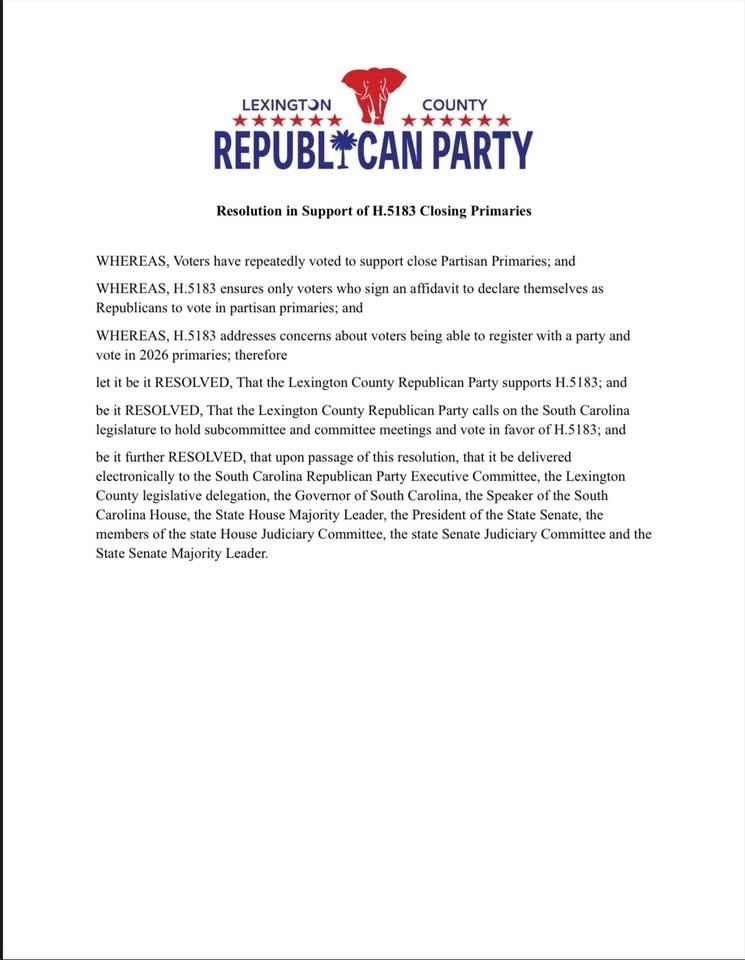
Resolution to support H.5183, closing the partisan primaries.
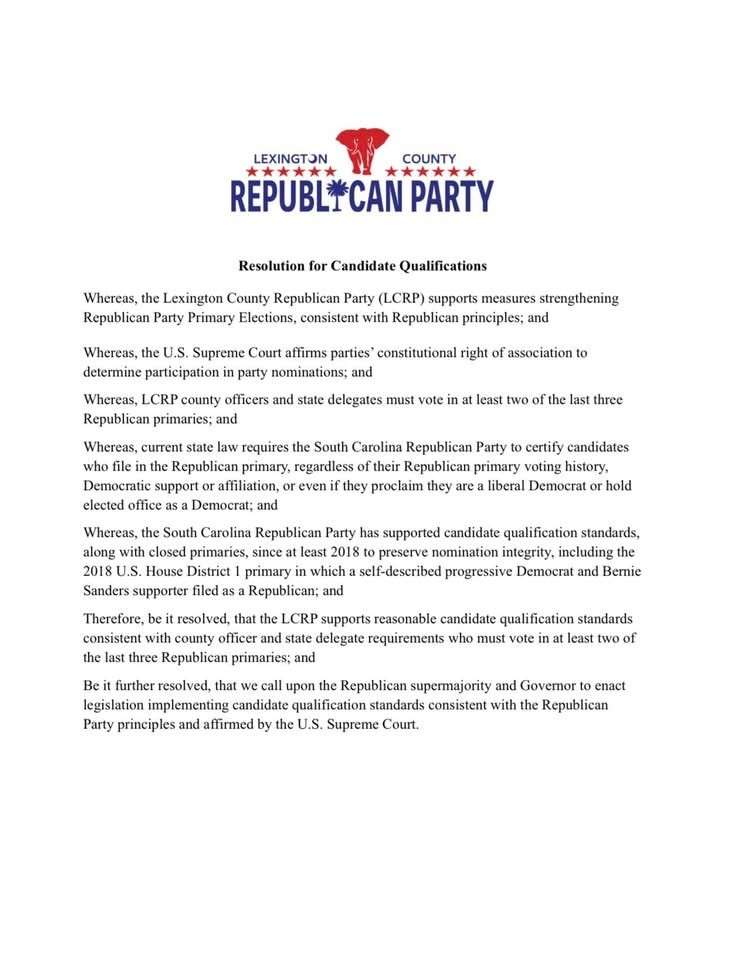
A resolution supporting primary candidates having to voted in two of the past three primaries.