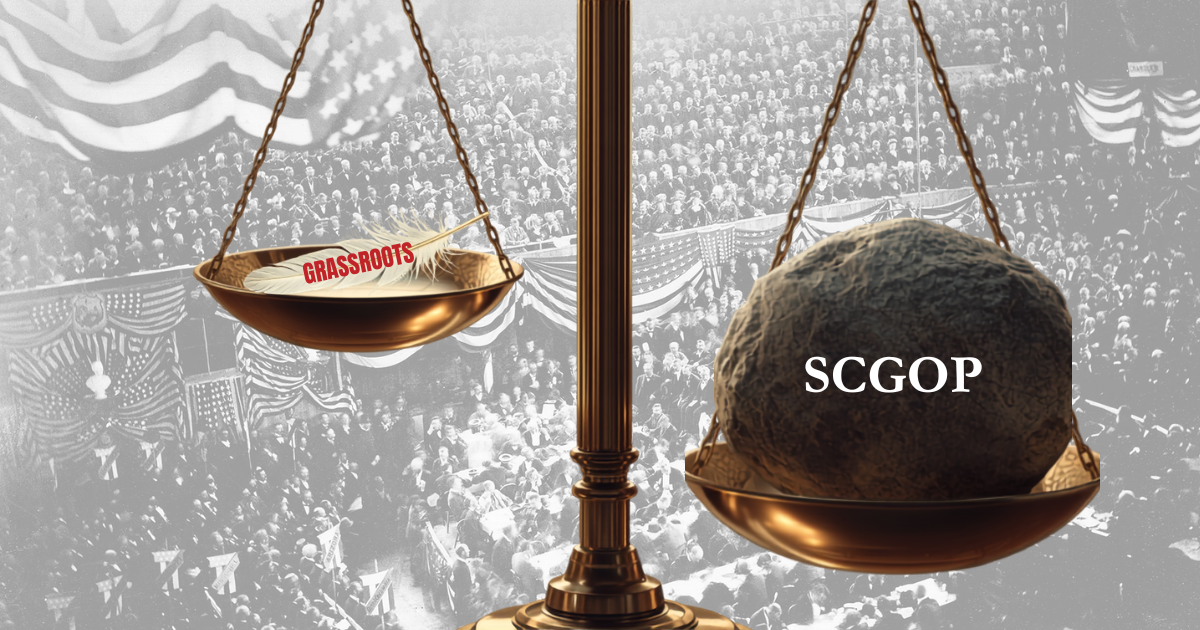
The SCGOP Guide to (Ramming Through) a Convention
On Saturday, June 27, delegates of the South Carolina Republican Party met for a special-called convention. After more than two decades of a state legislature ignoring the will of South Carolina Republicans, the State Republican Party was preparing a First Amendment case to determine who can participate in its primaries.
To those new to the convention process, one might assume the proceedings would be fair, orderly, and trustworthy. Think again.
SC Confidential has previously covered the convention here and here, as well as. the issue of closing primaries extensively. Our position has been clear: close our primaries, but do it the right way.
After viewing a revealing interview with the convention president, and after the events leading up to and during the special-called convention, any objective observer should ask two questions:
Why is the chairman exerting influence over the proceedings when he is supposed to separate himself from the proceedings and operate as a delegate?
How do these proceedings withstand scrutiny?
Why was it so important to eliminate nearly every procedural mechanism that allowed dissent?
Republicans and conservatives overwhelmingly support closed primaries. Many, however, do not support manipulating the process and breaking their own rules to achieve that goal.
December 2025
The SCGOP Executive Committee voted to endorse a proposal requiring party registration for primary voters while also requiring Republican candidates to have voted in at least two of the last three Republican primaries. The resolution also included legal threats directed at Republican legislators, warning them to close the primaries after years of neglecting the issue.
The proposal closely aligned with legislation introduced by Rep. Brandon Newton (R-Lancaster). Shortly thereafter, support for H.3643 collapsed as 32 legislators removed themselves as co-sponsors. Rep. Mike Burns’ (R-Greenville) H.3310, a cleaner closed-primary bill, began gaining support instead.
Eventually, Rep. Burns introduced H.5183 as a compromise between the previous proposals.
None of that mattered to legislative leadership, many of whom either support or are indifferent to South Carolina’s open primary system.
Many county parties pushed back.
Numerous county state committee members had initially voted in favor of the 2/3 candidate qualification requirement. Shortly afterward, many changed their position after realizing the implications of what had been adopted.
In February 2026, at my home county GOP in Lexington, leadership attempted to advance a candidate qualification requirement resolution. After lengthy debate, the proposal was tabled with only one member voting against tabling it.
May 2026
The SCGOP Rules Committee and Executive Committee approved a new set of proposed rules, triggering the June 27 special convention.
Once again, the proposed rules mirrored legislation that had failed to gain widespread support because of certain controversial provisions.
The proposed rules would:
Require candidates to have voted in 2/3 Republican primaries and have been registered Republicans for at least 90 days.
Limit voting in Republican primaries to registered Republicans.
Convention Day — June 27, 2026
According to Convention President Michael Lyons from a recent interview, the SCGOP Rules Committee approved a new set of convention standing rules approximately two days before the convention.
I personally first learned about these rules the night before the convention, before most of the attendees.
The provision that drew the most attention prohibited delegates from dividing the question - separating the candidate qualification requirement from the closed-primary proposal or amending the proposal unless 3/4 of delegates agreed. Under normal parliamentary rules, only a simple majority would have been required.
As delegates arrived for credentialing, many were surprised by several developments:
1. SCGOP Rule 2(F) requires delegates to have voted in at least 2/3 statewide Republican primaries.
Delegates were credentialed despite having voted only in the 2024 Republican primary. This was justified using a state law that expired in 2010.
Leadership in many counties had no idea this interpretation was being used. The blame was put on those leaders.
2. SCGOP Rule 5(c)(5) requires delegates to be elected by their county conventions.
Individuals who were never elected as delegates or alternates were credentialed.
In Greenville County, some individuals who intentionally skipped the 2025 reorganization and convention process were nevertheless seated.
Again, county leadership in many areas was unaware this would occur.
3. SCGOP Rule 5(c)(7) requires delegate and alternate lists to be submitted not later than five days of the county convention.
County conventions occured in the spring of 2025.
The credentialing issues were only the beginning.
4. SCGOP Rule 7(b)(2) requires the election of both a temporary president and a temporary secretary.
Only a temporary president was elected.
5. SCGOP Rule 7(b)(4) further requires the election of a permanent convention president, two secretaries, one or more vice presidents, a treasurer, and any additional officers deemed necessary.
This did not occur.
As an aside, despite comparing dissenters to Democratic Socialists multiple times, Mr. Lyons was more accomodating than past convention presidents.
These officers exist so the convention - not current party leadership - controls the proceedings.
Lyons was elected temporary president. Nevertheless, Chairman Drew McKissick repeatedly left his delegation and approached the stage during the convention to provide direction regarding the proceedings.
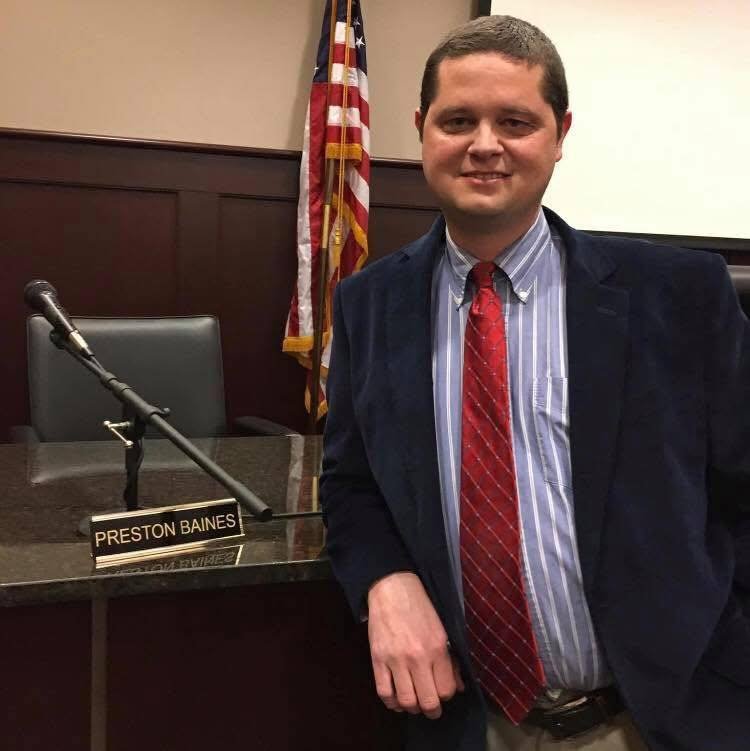
According to Lyons in a recent interview, McKissick specifically told him that a motion I made was improper. Lyons declined to follow that instruction and ruled my amendment in order.
My amendment simply sought to remove the 2/3 primary participation candidate requirement and the 90-day registration requirement while leaving the party registration provision intact.
Coincidentally, while I was speaking, several people around me - including my own Lexington County State Committeeman - insisted my motion was improper.
Ironically, that committeeman, Mr. McKinney, was himself credentialed despite not being an elected delegate, meaning he was ineligible to vote or make motions under the party’s own rules.
6. The convention's own Standing Rule No. 3 required delegates to address the chair from the designated floor microphone.
Calling the question ends debate and is one of the most consequential procedural motions available. Those motions, as well as seconding motions, were entertained and accepted from the floor.
Allowing anonymous procedural motions created unnecessary confusion and casts doubt on the legitimacy of numerous actions taken during the convention.
While not a violation of party rules, having only a single microphone created avoidable confusion.That is the first time that has occured in the many conventions I have attended.
Delegates crowded around one location with no orderly queue, leading to frustration among attendees on all sides. It was an easily preventable problem.
Herd Mentality
The proposed rules likely would have passed regardless.
But that is not the point.
The question is why party leadership appeared so determined to control every aspect of the convention while disregarding the party’s own rules.
Another question deserves consideration: What do delegates believe their responsibilities actually are? Are delegates seeking the spots simply for the title, or are they prepared to perform the duties entrusted to them?
Responsibility means showing up, understanding the issues, representing those who elected you, thinking independently and respecting the rules that govern the process.
Many delegates openly remarked that they wanted to finish quickly so they could leave to eat lunch. While that may have been true, the broader concern is that many appeared more interested in moving the process along than ensuring it was conducted properly or debating the issues.
From the county level to the national level, too many party officials treat the Republican Party as a celebratory party rather than serious governing meetings.
There is certainly a place for entertainment and fellowship, but the focus should be on reflecting our Christian and conservative values, taking responsibilities seriously and demanding accountability.
The South Carolina Republican Party has now filed a federal lawsuit asserting its First Amendment right to determine who participates in its primaries.
That raises one final question:
If the party is willing to disregard its own rules and tolerate procedural irregularities while adopting these rules, how can it expect a court to view those same rules as the product of a fair, orderly and credible process?